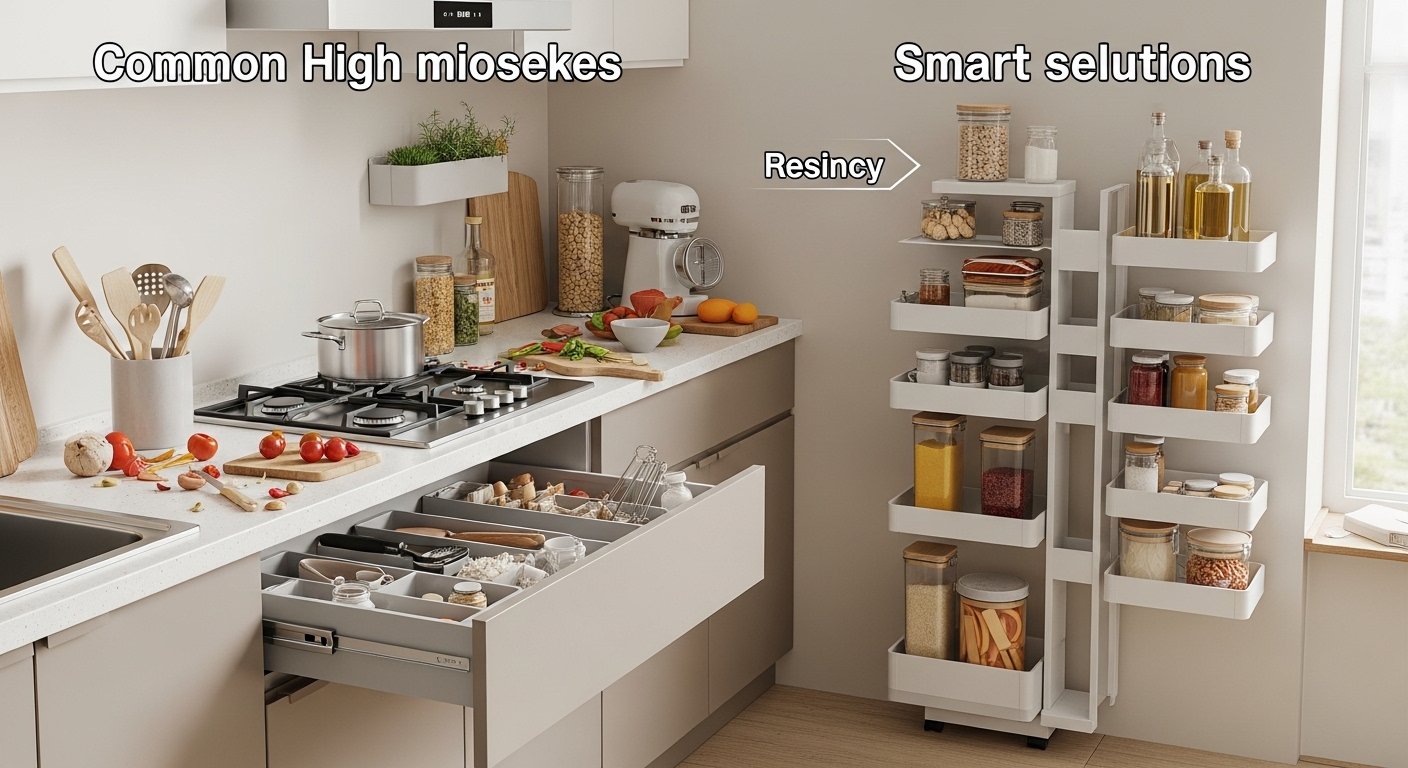
The kitchen is one of the home’s most time-consuming areas—not just
due to tasks, but small repeating organizational errors with cumulative
impact we overlook. Many feel they spend too long in the kitchen despite
good space, available tools, and even apparent tidiness. The truth? The
issue often lies not in kitchen size, but organization and tools used
inside.
Environmental psychology and functional space design studies show
poor daily tool organization can increase household task time by up to
30%—a significant figure over a week or month.
Mistake #1: Relying on Traditional Storage Instead of Smart Solutions
A common error is using plain drawers and cabinets without internal
smart organizers.
When drawers hold everything openly:
•Functions overlap
•Tools pile up
•Time wastes on searching and sorting
A Journal of Household Efficiency study showed internal organizers (like
drawer dividers or vertical storage units) noticeably reduce access time
to daily tools.
The difference isn’t more drawers—it’s smart tools turning each into a
clearly functioned space.
Mistake #2: Cluttering Work Surfaces with Tools
Work surfaces should be clear and movement-friendly.
Yet many kitchens have:
•Rarely used small appliances
•Scattered spice containers
•Tools without designated spots
This clutter consumes not just space, but attention.
Visual perception research indicates the brain takes longer to process
crowded scenes, slowing performance subtly.
Smart solutions don’t mean removing everything, but using:
•Vertical storage units
•Built-in spice organizers
•Wall-mounted holders instead of surfaces
Mistake #3: Too Many Tools… Without Quick-Access Systems
Many own excellent kitchen tools but underuse them due to poor
organization.
When daily tools store with rarely used ones, every meal prep becomes a
mini-search.
Per Frequency-Based Organization principle, daily tools should be:
•At eye or hand level
•Easy to pull and return
•Unblocked by other items
Here shine smart products like:
•Pull-out pot organizers
•Multi-tier racks
•Flexible storage adapting to tool sizes
These save space and reduce unnecessary movements during work.
Mistake #4: Ignoring Exploitable Small Spaces
Small kitchen gaps are often neglected:
•Cabinet sides
•Appliance gaps
•Door interiors
Interior design studies show smart storage in these cuts overall clutter
without expanding space.
Products like:
•Side storage units
•Behind-door organizers
•Narrow multi-use shelves
Turn dead spaces into daily-use assets.
Mistake #5: Using Inflexible Tools Amid Changing Needs
Kitchens are dynamic, needs shift with:
•Family size
•Cooking style
•Daily routines
Rigid, inflexible solutions age the kitchen functionally fast.
Adaptive Design studies note adjustable, rearrangeable tools maintain
efficiency longer.
Prefer products:
•Expandable or shrinkable
•Multi-purpose
•Easy to move or modify
How to Cut Kitchen Time Without Extra Effort?
The solution isn’t:
•Buying more tools
•Completely redesigning
But choosing smart tools matching your real daily behavior:
•Faster access
•Clearer storage
•Easier movement
•Less stressful decisions
When every tool has a clear spot and every space a defined function,
daily micro-decisions drop unnoticed.
A Smart Kitchen Doesn’t Mean Tool-Filled
A smart kitchen:
•Works seamlessly
•Reduces your effort
•Respects your time
The real difference shows not day one, but week’s end—when you
accomplish the same tasks with less time and more energy.
For smart kitchen aspirations, browse our products for easier living with
Handesly