Curtains
What Stays in Memory Are the Details
I watched a movie yesterday. I didn’t remember the hero’s name or the story’s
details as much as I remembered the look of the bathroom in a scene that
lasted less than a minute. The calm lighting, the towel in its place, and the
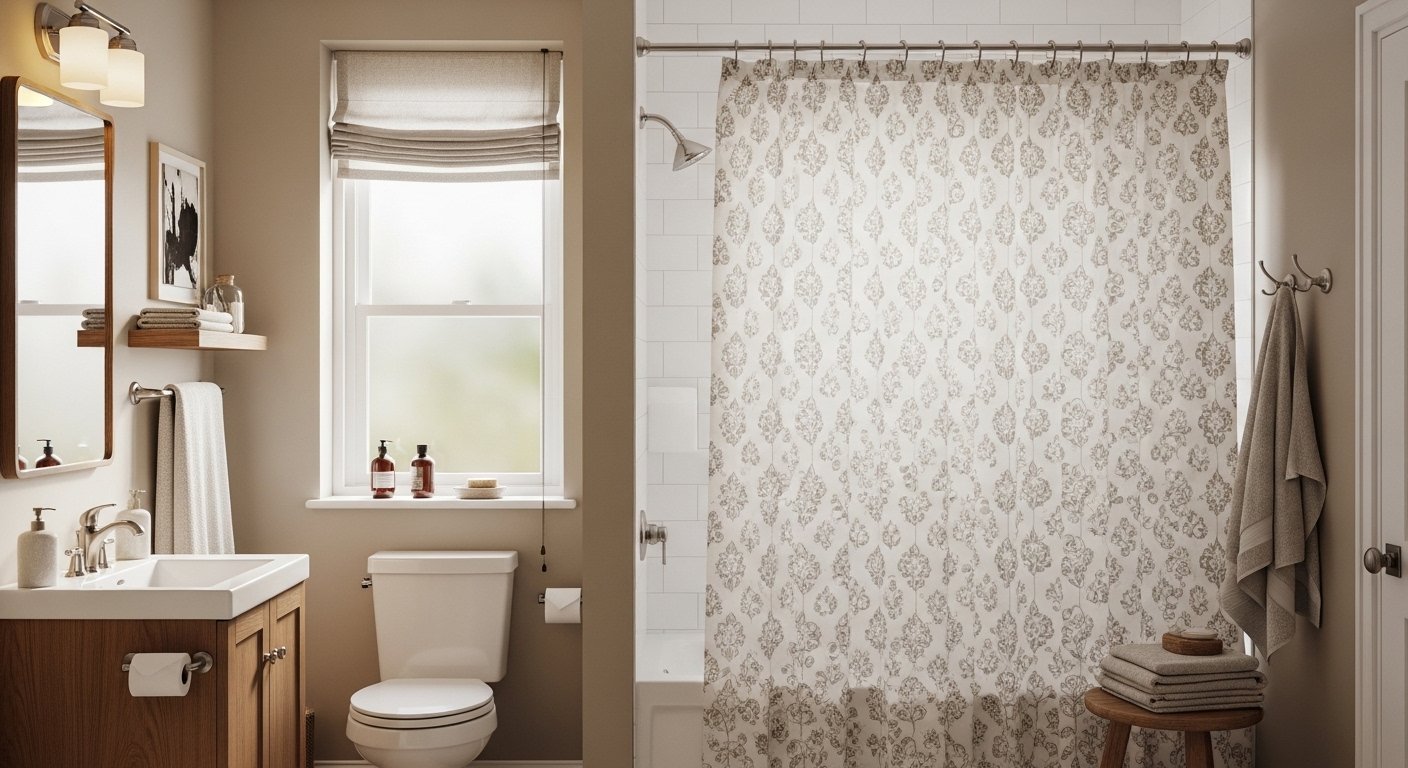
shower curtain with its distinctive color and thoughtful design. It wasn’t just a
curtain — it was a clear visual element speaking about its owner’s personality
without a single word.
Have you noticed this too in films and TV series? That bathroom scenes
always look tidy, elegant, and complete? It’s not by chance. Designers know
that small details are what stay in memory. In this article we’ll discuss the
simplest and fastest way to transform your bathroom from an ordinary space
into one that makes you feel cared for and tasteful every single day.
The Bathroom: The Most Used Space and the Least Attended To
When setting up a new home, especially for those about to get married or
newlyweds, we put all our focus, budget, and energy into the bedroom, living
room, and kitchen. The bathroom? It usually comes last. It’s treated as a
purely functional space.
But reality is completely different: the bathroom is one of the most used
spaces daily, and it’s the first thing guests notice when they need to use it.
And the simplest element that can completely change its visual scene is the
shower curtain — because it occupies significant visual space and is the first
thing that catches the eye when entering.
Why the Shower Curtain Specifically?
Because it makes up between 30 and 40 percent of the bathroom’s total visual
space. Think about it: one piece covers a third of what you see when you
enter the bathroom. Its color affects the overall feel of the entire space; its
design determines whether the style is modern, classic, or bohemian; and its
material reflects the level of attention to detail. Sometimes changing just the
curtain makes the bathroom look as if it has been completely renovated — at a
cost no greater than a meal at a restaurant.
A Guide to Choosing a Shower Curtain for Every Style
For a small bathroom: choose light, bright colors like white, beige, light blue,
and soft green to give a sense of spaciousness and openness. Avoid large
patterns and heavy dark colors that make you feel cramped in small spaces.
For a modern, minimalist design: a curtain in one strong solid color — black,
dark gray, mustard, or deep green. Or calm geometric patterns in black and
white.
For a classic or French style: soft patterns like small florals or delicate wavy
lines. Warm tones like cream, muted gold, and antique pink add simple
elegance.
For a bohemian, natural style: natural undyed linen fabric or warm earthy
tones. Materials that look natural and handmade rather than manufactured.
Small Details That Complete the Picture
A good curtain needs simple completion to finish the visual scene: an
appropriate curtain rod in a coordinated color; curtain rings — whether metal,
wood, or plastic — suitable for the style; and matching towel holders that
complete the composition. These small details are the difference between an
ordinary bathroom and one that makes visitors feel that its owner cares about
every single detail.
From a movie I watched, I learned that details are what stay in memory. In
your home, guests may not notice the large furniture first — but they’ll
immediately feel the level of attention to small details. Share with us in the
comments: What’s the first thing you want to change in your bathroom?
And if you’re dealing with a living room that seems cramped even though it
isn’t, and you want a scientific, practical solution, don’t miss our next article: ‘I
Can’t Sit Down! The Living Room Is Too Small.’