Small
‘How did the living room become so cramped?’ This is a question many people
ask as they feel frustrated by a room that appears overcrowded even though
its actual size isn’t necessarily small. The shocking truth revealed by interior
design science: in more than 60% of cases, the feeling of tightness doesn’t
come from the size of the space but from how elements are distributed within
it.
More clearly: a room that is actually small in size can look spacious and
comfortable, while a larger one can appear suffocating and crowded. How?
That’s what we’ll reveal in this article through six scientifically grounded tips.
The Science Behind the Sense of Space
According to multiple studies in interior design and environmental psychology,
the human eye doesn’t evaluate spaces based on their actual metric
dimensions — it evaluates them based on what are called ‘visual pathways’:
the imaginary lines through which the eye moves within any space. When
these pathways are clear and open, the eye senses flow and spaciousness.
When they’re blocked by furniture or visual clutter, the eye immediately senses
tightness and crowding.
Tip One: Furniture Away from the Wall
The common belief that pushing every piece of furniture against the wall frees
up more space in the middle is incorrect. Studies indicate that leaving a small
gap between furniture and the wall — ranging from 5 to 15 centimeters —
creates a sense of visual depth and makes the room appear much larger.
When furniture touches the wall directly, the space looks like a closed wall with
no depth.
Tip Two: Multi-Function Pieces
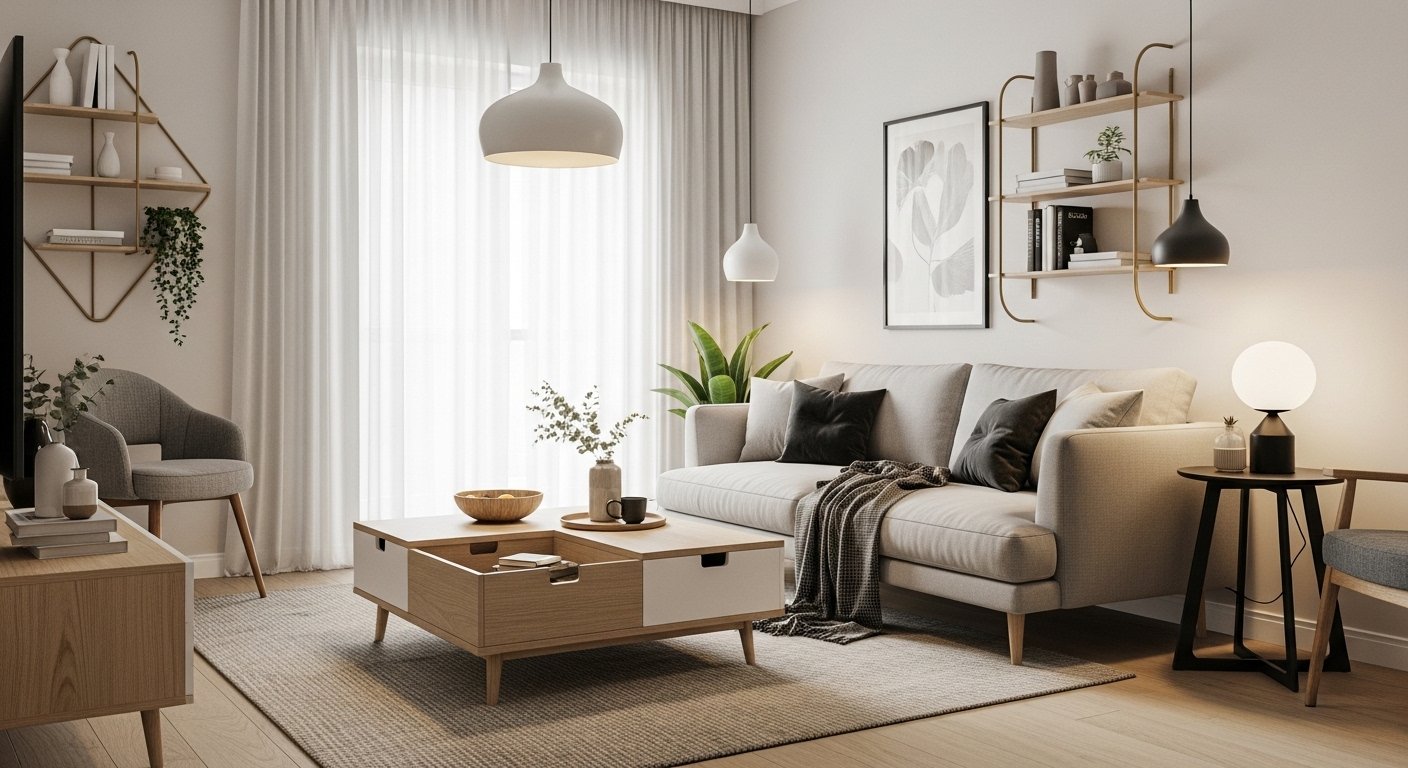
In limited spaces, every piece must serve more than one role. A coffee table
with a storage drawer eliminates the need for an additional storage unit. A sofa
that opens as a bed eliminates the need for a separate guest room. Wall
shelves replace bulky floor storage units that consume space and burden the
visual scene. Reducing the number of visible pieces is the primary key to a
room that looks wider.
Tip Three: Colors and the Science of Visual Perception
Light colors on walls reflect light, making the room appear visually larger by up
to 20% compared to dark colors. This isn’t just an aesthetic opinion — it’s a
proven fact in visual perception science. Dark colors absorb light and make
spaces appear smaller and more closed. The smart solution is using light
colors for walls and ceiling, while adding dark accents in pillows, curtains, and
accessories to create visual depth without weighing the space down.
Tip Four: Exposed Legs Create Spaciousness
Furniture beneath which the floor can be seen creates a much greater sense
of spaciousness than furniture that sits directly on the floor. When the eye
sees the floor extending under the sofa or under the side table, it interprets the
space as larger than it actually is. This is why many great designers have
chosen sofas and tables with visible, slender legs in small spaces.
Tip Five: Fight Visual Clutter
Visual clutter is the presence of many visible things simultaneously, even if
they’re small and individually harmless. The human brain expends mental
energy trying to ‘clean up’ a complex visual scene, which makes us feel tired
and vaguely anxious without knowing why. Reducing visible elements by just
30% can noticeably decrease the feeling of crowding and make the room
appear calmer and more comfortable.
Tip Six: Lighting Is More Powerful Than Space
A well-lit room always looks larger than a poorly lit one, even if it’s actually
smaller in area. Good lighting means: multiple light sources distributed
throughout the room rather than a single central one; maximizing natural light
through transparent or lightweight curtains; and adding warm side lighting that
adds depth to the space and makes it appear richer.
The living room doesn’t need bigger walls or new furniture. It needs smarter
decisions and the application of simple scientific principles. When you
understand how the eye perceives space, you can completely reshape its feel
— often without spending a single extra coin.
And if you’re wondering how to create the ideal environment for your child that
helps them stay organized without ordering them around or arguing, don’t miss
our next article: ‘You’re Creating a Messy Child.’